Begun as a story by story blog of my Journey Through the Whoniverse this is a Doctor Who review blog. If you haven't seen any of the stories then beware the dreaded SPOILERS. If you want detailed reviews this ain't the place. These are more spur of the moment instant judgements focusing on what gets my attention. I hope you like it.
Sunday, November 6, 2011
Mark of the Rani
Mark of the Rani is not all bad I'll give it that.
Kate O'Mara is excellent as the Rani and the character is a breath of fresh air. She is contemptuous of the Master's 'devious and complicated' plans and the Doctor's morals. She mocks the Master's fight with The Doctor with panache. But then they go and team her up with The Master.
Now The Master is an idiot in this story & you wonder why the Rani just doesn't kill the skulking fool and get on with it. The Master also appears to have disguised himself as a Scarecrow and stood in a random field to await the Doctor's arrival. Now, why would he do that? Why? Then he ditches the scarecrow disguise & is back in his 'I'm off to do evil things' outfit as soon as possible.
All the Time Lords in this story get to do some dressing up. The Rani as an Old Crone, The Master as a bloody Scarecrow and the Doctor (temporarily and unconvincingly) as a workman in need of a bath. Colin Baker's impressive mop of blonde curls should have put the kibosh on that disguise straight off and why it takes the Rani two minutes to suss it is the Doctor whilst he is unconscious is beyond me.
Then there are the accents. I'm assuming this is supposed to be set in the north-east somewhere - after all Stephenson's from Northumberland by birth - but some of the faux Geordie-Tyke-whatever is bloody appalling. And some of the minor actors are pretty terrible but given that most of the time they're given little to do except shouting a lot and rage rather unconvincingly I don't think they can take much of the blame. But if I hear another pseudo-Geordie mention of 'Tobys' I might just smash something up.
But I must remember that this isn't all bad. Colin Baker is excellent - again. I like his mischievous glee when he gets a chance to have a go at the Rani's TARDIS. So too is Terence Alexander as Lord Ravensworth and Gawn Grainger as Stephenson. Gary Cady as Luke Ward is a bit difficult to take seriously if you have strong memories of the rather wonderful Brass but does a reasonable job of a pretty bland part.
The fact that a lot of the story is filmed on location in Shropshire helps to. The opening shot, in particular, does a fantastic job of setting the scene and period. It's all rather refreshing but once again when one moves into a studio in a story like this it often feels and looks studioesque. The change from film to video being part of the reason.
However, the location filming doesn't excuse one of the most pathetic pieces of special effect in Doctor Who's long history. I'm talking about the 'Luke Tree' saving Peri. The idea of the Rani's clever little mines is one thing but it is at moments like this you wonder why someone didn't say: "Look this Luke Tree branch thing...it's going to look bloody ridiculous unless we have time and money to do it properly. This is Doctor Who so we won't have either. Let's write something else." But no. So we get a very plastic-looking tree fondling Peri. Then we get two big plastic-looking trees supporting an uncomfortable-looking Colin Baker. It's like someone has gone: "So you've suspended your disbelief thus far. Let's see how you feel after THIS. No...what about THIS. HaHaHaHaetc"
It's a shame really because the writing in this story isn't too bad. Pip and Jane Baker get a lot of flak but it isn't too badly written this story. It's too 'busy'. Why have the Master and the Rani when one will do? In fact, since you've apparently killed off the Master once & for all - something the Rani seems to know about btw. How is this? Do they have a Time Lord Twitter? Bringing him back makes this story too crowded and in comparison with the Rani the Master ends up looking like a total twonk. He is less Moriarty, more Sylvester Sneekly.
So if you ignore some terrible accents and acting, a surfeit of Time Lords, the terrible Luke Tree, The Master's stupidity this isn't entirely bad. It isn't that good though. Go and watch Vengeance on Varos again. It's much more fun.
Saturday, November 5, 2011
Vengeance on Varos
I love Vengeance on Varos, although watching again it is clear that the first episode is far stronger than the second.
It might be studio-bound but that's because it is effectively set in a television studio where some rather unpleasant games take place. Varos is a former prison colony that has adopted trial by television as the main driver of its constitution. The Governor rules as long as he can survive the votes of his population. It is as if Simon Cowell had been allowed to create his own government: rule by reality television.
Criminals on Varos are punished by live execution. The videos of which are exported to other planets for the enjoyment of people who like that kind of thing. It isn't a pleasant planet to live on. Life - to use an old cliche - seems nasty, brutish and; short. Part of the reason for this is that the people of Varos have no idea that they are sitting on a gold mine...well not a gold mine but a Zeiton 7 mine. Zeiton 7, a miraculous McGuffin of the week, is an important mineral required for time-space machines the universe over. Somehow the Varosians have missed this fact & have allowed themselves to be robbed by the Galatron Mining Corporation.
The envoy of the Galatron Mining Corporation is Sil, who is a fantastic creation. He's played with gurgling brilliance by Nabil Shaban. Shaban makes Sil one of the most memorable monsters of the 1980s, partly because he's a rare new addition to the list of Doctor Who enemies and partly because he's so well-acted and designed. Sil's laugh is particularly memorable but so is his sadistic glee, deviousness, and cowardice.
Shaban isn't the only excellent performance though. Martin Jarvis as The Governor is also great. What sometimes gets forgotten is that the Governor isn't that pleasant a man. He might just be doing his constitutional duty but this is a man who oversees the murderous day-to-day life on Varos. Yet Jarvis makes him seem sympathetic, especially at his most tired and weary. But his stand-off with Peri, where she dismisses him with the line "And I thought you were better than the rest of these brutes" shows the fine moral line between the Governor and his compatriots. He's also nicely underplayed. No histrionics required.
Also, Forbes Collins does a fine job as the corrupted and devious Chief Officer.
Jason Connery as Jondar is a bit wooden but I'll forgive him that as apparently it was his first-ever television but still, he does look a bit all at sea when most around him is actually jolly good. Owen Teale, a fine Welsh actor also appears as Maldak. Oh and I bit of a minor boo for Nicholas Chagrin as Quillam who - with the exception of two elderly nappy wearing cannibals - is the most over-the-top person in a story that doesn't really need them.
In fact, the Quillam and the transmogrification sub-plot is a bit unnecessary if you ask me. Another example of over-egging the pudding but Peri's transmogrification is nicely done.
What I think makes this story excellent is the way it is both a Doctor Who story & a commentary on television. There's a chorus - watching at home - in Arak (Stephen Yardley) & Etta (Shiela Reid) who occasionally comment on the action & the cliffhanger at the end of Part One is marvelously post-modern. The Doctor's dying & we hear the Governor & his team giving direction on how to film the scene and it is one of my favorite Doctor Who cliffhangers ever.
As I said at the beginning though Part Two is less effective. The ending is a bit rushed & overly convenient. And again - after Attack of the Cybermen - the Doctor seems to choose the path of violence over peace by organizing the deaths of Quillam and the Chief Officer through poison, which doesn't feel quite right. Neither does his post-acid bath James Bondesque quip. It's just a bit flippant. I don't have an issue with violence, even realistic violence but I do have a bit of issue with it being treated flippantly.
However, despite the quibbles, I think Vengeance on Varos is a fine story. Colin Baker is excellent, Nicola Bryant who - in her words from the DVD commentary is 'in another leotard, another day - is also fun, even if she doesn't get a great deal to do this time.
It's worth watching though and is definitely the best Colin Baker story (so far).
Friday, November 4, 2011
Attack of the Cybermen
Attack of the Cybermen annoys me. It has an excellent cast playing - generally - interesting characters, the dialogue is generally pretty good and I like the Cryons. But...but it has the same bleakness that Resurrection of the Daleks does and is directed by the same director, Matthew Robinson) and to me doesn't feel 'right'.
I understand the arguments often trotted out by Eric Saward - the then script editor - that violence has to be shown to hurt but there's a difference between that and a desire to kill everyone to prove a point about making things seem realistic. Doctor Who isn't meant to be realistic or pessimistic, at least to me. And as character after character is killed off it just seems gratuitous and cruel. I suspect that's might be the point but I don't like it. It's just nasty. Particularly so in the case of the deaths of Bates (Michael Attwell), Stratton (Jonathan David) & Griffiths (Brian Glover), which are totally unnecessary. What harm would it have done to the story if they'd got into the timeship and escape? Eric Saward talks about it as 'poignant' but it isn't. It's just nasty. The bathos comes from Lytton's death and the Doctor's misjudgment of him (although as Lytton spent most of his previous meeting with the Doctor killing people is that really unexpected).
Anyway, that's my rant over.
Actually, there's another little rant: Peri's costume at the beginning of the story. A bright pink leotard and shorts. It's not exactly practical, even if it is pleasant to look at. Indeed for once you find yourself NOT looking at Colin's jacket. However you do think someone in the production team - JNT I'm assuming - is trying to work out how little clothing he can put Nicola Bryant in before someone complains. It's almost a relief when on reaching Telos the Cybermen get her some warm clothes to wear. [This may be a sign I'm getting old.]
Overall though this story isn't bad. The Cryons could have been better designed: the plastic is all a bit too obvious but I quite like the idea of them, even if their nails seem a tad impractical for guerilla warfare. Their addition to continuity (after all where were they in Tomb?) actually doesn't seem too harmful and the actresses playing them all do a fine job. They get some good lines.
The cast is excellent: Maurice Colbourne is magnificently dry and nasty as Lytton; Brian Glover as Griffiths seems surprisingly 'real' for a minor Doctor Who character. He sounds like a normal bloke if a bit dim and his reactions to Lytton's insults are lovely. Terry Molloy does a good job playing the slightly bland Russell. Michael Attwell is quite scary as Bates, bullying the slightly wet Stratton and shouting a lot. But effectively. There's a difference between the Attwell type of shouty acting and (to pick an example at almost random) the Prentis Hancock style.
Colin Baker is great again. I don't have a problem with his killing various Cybermen because what was he supposed to do, talk to them sternly? He gets some great scenes with Colbourne and the Doctor's reaction to his misjudgment of Lytton is nicely played.
Peri - costume aside - is a bit annoying in Part One is a bit whiny and Teganesque but improves as the story goes on.
Oh, a quick mention of the terrible cliffhanger at the end of Part One. All that no, no noing is really silly and badly directed.
Actually, I should also mention that we're now in 45-minute episode territory, rather than 25 minutes and it does feel quite nice. There's no desperate dash for a cliffhanger all the time, which allows the writers to develop characters more, especially as unlike 'New' Who the stories are always more than one episode & can breathe a bit.
I was about to say that this is a good script but not that enjoyable to watch but then I remembered the amount of continuity. Did the general viewer understand all the references to Telos-Mondas? Did you really need to cast Michael Kilgariff as the Cybercontroller just because he'd played the part in The Tomb of the Cybermen? In the decade or so that had passed the Cybercontroller has put on a few stones, obviously & it looks silly. It's like being force-fed the history of Doctor Who, especially early in Part Two when the Doctor, Peri, Lytton, and Griffiths take part in a lecture on Cyberhistory. I'm surprised David Banks didn't take part.
So too much continuity, too bleak and one silly cliffhanger but not terrible. Just annoying. To me.
Thursday, November 3, 2011
The Twin Dilemma
The Twin Dilemma has its negatives. Lots of them. There is one of the worst villains in Doctor Who history: Mestor the giant cross-eyed slug. Battling away with The Myrka and that bloody giant prawn from The Invisible Enemy as part of the cavalcade of the unloved. Mestor is richly voiced by Edwin Richfield, a British television regular whose face you would know, even if the name means nothing and here he is dressed as a giant slug working bloody hard to be a convincing threat. It is no shame on Richfield that Mestor is about as threatening as a marshmallow. It's the design. If your monster can't walk unaided then I'd suggest you are on something of a loser.
So the main villain is rubbish.
There's some distinctly average acting going on: Helen Blatch as Fabian and Dione Inman as Elena I'm looking at you in particular but the worst are the Conrad brothers as the eponymous Twins (although I'm never quite sure what the Dilemma is in this story.) I'm not sure you can entirely blame them. Child actors are notoriously hard to cox a performance from at the best of times and being asked to play an indistinguishable pair of smug mathematical geniuses isn't ideal. It's like Adric squared. But they aren't great and this does hobble things a wee bit.
So the main villain and the Twins are rubbish.
The script by Anthony Steven isn't great and the direction, particularly after Graeme Harper's sterling work on Androzani, is positively pedestrian.
So average script, bland direction, terrible Twins and the villain is a cross-eyed giant slug.
This isn't looking good is it? And this the first story of our new Doctor, Colin Baker.
Now Colin is great in this. Yes, he's bombastic, theatrical, loud & dangerous but he is Doctor-ish. All the post-regeneration instability does make you question this new Doctor and it was brave to make him seem so unlikeable in the beginning. All of this works though and makes Colin immediately different from his predecessor. However, Colin Baker's Doctor is sabotaged from 8 minutes and 21 seconds into Part One.
Why then? Because that is when he puts on that costume. From that moment he's stuffed. Everyone and everything is in competition with that costume and it isn't good. It makes a little sense whilst he is suffering from post-regeneration trauma but once he's recovered...? One of the reasons The Sixth Doctor is so great in the Big Finish Production is that Colin can be the Doctor without competing with his own ridiculous costume. Colin Baker proves in this story he's a bloody good actor and he could have been a great Doctor but a combination of BBC inertia, producer fatigue and that stupid bloody costume hamstring him. Not always and not entirely but enough.
Nicola Bryant does a generally good job, especially her dislike of this new person clumping about the TARDIS trying to strangle her. Kevin McNally does a fine job of being sarcastically heroic as Hugo Lang. Praise also for Barry Stanton (Noma), Seymour Green (Chamberlain) and Oliver Smith (Drak) who do a fine job as bird-ish Jacondans. Noma's a git, the Chamberlain is a creep and Drak a doomed hero and all give their characters a certain panache. Also unlike the terrible Mestor costume, the designs for the Jacondans look lovely: feathers, silver skin and beaky noses.
Most lovely of all though is Maurice Denham as Edgeworth/Azmael who gives a world-weary touch to even the banalest lines and gets a lovely little death scene.
So The Twin Dilemma isn't great but it isn't quite as bad as its reputation suggests. It's entertaining enough if you can ignore the cross-eyed slug, there are some nice performances & Colin Baker gets properly introduced.
However, I wouldn't reach for this one to impress the non-Doctor Who fan.
Sunday, October 30, 2011
The Caves of Androzani
Damn this is a fantastic story. You can even forgive it the lumbering, stumbling Magma Beast and its contribution to the only dud episode ending out of the four. It's the best send off the Fifth Doctor could have had and perhaps the best story of his entire era.
The direction by Graeme Harper is fantastic. The story moves with a drive rarely seen in Classic Who. It is no wonder Harper got the call to direct New Doctor Who. After all, this story could quite easily be a New Who story, particularly a David Tennant one except that in the end, the Doctor sacrifices his life not to save the Earth, the Galaxy or the Universe but to save a single person: Peri. It's summed up in that fantastic scene that turns into the cliffhanger to Part Three.
But this story is filled with great stuff and great performances. Maurice Roƫves as Stotz, the Mercenary. A surprisingly gritty character that might be more at home in a series like Blakes Seven; John Normington as Trau Morgus the unacceptable face of capitalism playing both sides for maximum profit; Martin Cochrane as Chellak, who does a fine job channeling the military mind & gets one of the most unpleasant (off-screen) deaths in the programme's history; Robert Glenister as Salateen (and his android copy); Roy Holder as Krelper, the most whingy of mercenaries & constantly complaining whilst constantly being bullied by Stotz; Barbara Kinghorn as Timmin, who appears just to be Morgus's PA but ends up stitching him up magnificently as things spiral out of control towards the stories end.
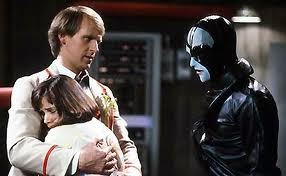
Topping the guest stars off though is Christopher Gable as Sharaz Jek. Initially, Sharaz Jek looks like the first in what will be a long line of villains with a taste for Peri's looks and a bit of a Phantom of the Opera wannabe but there's depth to Sharaz Jek and self-awareness often missing from Doctor Who 'villains'. He is mad, he says so himself. His physical condition and his burning desire for revenge against Morgus have driven made him mad but he remembers being something else, something better. That's what Peri reminds him of. So it isn't lusting that makes him want to keep Peri his prisoner, it is a desire to be himself again. To enjoy life and beauty and love. There might be an element of snobbery there too. His disgust at having to deal with the 'dregs' of society is the whinging of an upper-class chap down on his luck. Nonetheless, Sharaz Jek is a sympathetic character & his reaction when Peri sees his face for the first time without the mask and she screams is heart-breaking.
Sharaz Jek isn't meant to be the real villain of the story anyway. That's Morgus, the capitalist willing to blow up an entire mine to solve an over-supply problem. A man whose only motive is the profit motive. Coldly shutting factories, killing politicians and generally behaving like a cold-hearted monster. Morgus betrayed Sharaz Jek and everything in this story is the result of that decision. Then the Doctor and Peri walk into the middle of things.
Nicola Bryant does a sterling job in this story giving Davison real support as things begin to end. It is a shame we never got to see more of them as a team - at least on television - as I think they work well together. She's got gumption has Peri.
But what of Peter Davison himself? Well, I've enjoyed his performance as The Doctor. I think sometimes Davison suffers from being between Bakers both of whom are much louder and theatrical than Davison. Davison is like the player in a football team who does the simple, boring stuff well but gets ignored because some of his teammates do the great stuff well some of the time. He's a very human Doctor and in a lot of ways the template for David Tennant's Doctor in my opinion. Davison is Tennant is slow-motion or - to get it the right way round - Tennant is Davison on fast-forward.
The Davison era also suffered from the BBC's growing lack of affection for Doctor Who & JNT's desire to please the hardcore fans of the series more than the general viewing public. Too often great ideas were let down by lack of time and money. There's some great Doctor Who during the Davison era: Castrovalva, Kinda, The Visitation, Earthshock, Snakedance, and Caves itself. There's some terrible stuff too Time-Flight; Arc of Infinity; The Kings' Demons; Warriors of the Deep and Resurrection of the Daleks. But through it all, I think Davison does an unappreciated excellent job. At least, in this story, he gets the farewell he deserves and probably the best regeneration story in the series history as well as a memorable and moving regeneration sequence.
So Farewell Peter Davison and thank you...hello Colin Baker.
Saturday, October 22, 2011
Planet of Fire
Planet of Fire is a busy little story, isn't it? The writer Peter Grimwade has to introduce Peri (Nicola Bryant) as the new companion, write out Turlough (Mark Strickson); eliminate Kamelion, dispatch Anthony Ainley's version of The Master AND put together a story that works. The fact that Planet of Fire is enjoyable, if flawed, is something of a tribute to Grimwade's abilities.
Let us start with the flaws: Dallas Adams's performance as Peri's stepfather Howard (in both his 'real' and Kamelionised forms) is pretty wooden and Edward Highmore as Malkon, 'the Chosen One' reflects some of his inexperience as an actor. There's also some terrifically hamtastic face-pulling being done by the silent supporting actors playing the Elders of Sarn, which undermines their authority somewhat. It is no wonder Sarn is packed full of heretics if that lot are the best leaders the place provides. I'd be a bit cynical about Logar if I was being ordered about by a gang of pudgy middle-aged men with over-theatrical responses to everything going on around them.
The exception to that is Peter Wyngarde as Timinov, the Chief Elder and Logar's best believer. Wyngarde invests him with a combination of dignity and disappointment that is quite winning. Timinov's decision to die on Sarn rather than leave for Trion in the rescue ship is quite movingly done, especially as arch-skeptic Amyand (played with heroic straight-forwardness by James Bate) makes an attempt to convince him by using Timinov's faith. It's a nice moment and in an odd way reminds me of the scene between President Bartlett and Father Tom Cavanagh at the end of the 'Take This Sabbath Day' in Season One of the West Wing where Father Cavanagh tells the story about the believer that ends with the line: "I sent you a radio message, a boat, and a helicopter what are you doing here."
The decision to use Lanzerote as both itself and Sarn seems a good one but only makes the studio sets look conspicuously small and artificial. The Master's TARDIS in 'column' form looks particularly lightweight for example. But the volcanic island serves well as an alien planet and certainly makes something of a change from Buckinghamshire quarries. It also looks stunning when we first see the wreckage of the Trion ship across an expanse of volcanic sand and rock.
Nicola Bryant does a good job in her first story as Peri. It's well-known that the decision to make Peri American - like the decision to make Tegan an Australian - was made by JNT to pander to a possible export market for Doctor Who. Thus missing the point that one of Doctor Who's selling points is its Englishness in a world of American science-fiction franchises. Nicola Bryant is English of course. But hey ho. Her American accent stands up to my basic scrutiny pretty much most of the time. I could here go on about how much Peri's bikini scene affected this - then - thirteen-year-old boy but I suspect that will freak you out. Nicola Bryant will go on to be put in some of Doctor Who's most revealing outfits, which generally make little sense when clambering about the universe and the bikini probably tops the list. However, it does make sense for her to be wearing it. She's about to go swimming and the shots of her in it don't have quite the lecherous quality that the introduction of Mary Tamm as Romana I seems to have. There are moments when you can tell Bryant isn't the world's most experienced actor but she's a bit of a breath of fresh air. Maybe it is enthusiasm.
Then we come to Anthony Ainley's apparently last stint as the Master. I do like the cliffhanger that reveals the miniature Master in his little control box that explains why he's going to such complicated lengths to get Kamelion to 'the contact point'. There's something quite interesting about the Master being in peril but still having the balls to try and bully Peri into helping him once the truth of his situation becomes obvious. The Master's end is a nasty one and I'm not sure I'm entirely comfortable with the Doctor just standing and watching. Even if he CAN'T do anything I think he would TRY. Doing nothing is not very Doctor-ish in my view.
Whether the Master will return and how his survival will be explained is - of course - for us to find out at another time. [Pretends never to have seen a Doctor Who episode after this one EVER]
Despite its busyness, the story still tries to find time to have a debate about faith, doubt and about how myths and history can sometimes end up being the same thing but squeezed between the fundamental needs of an adventure series all that high falutin' stuff gets a bit lost but the previously mentioned Amyand - Timinov scene makes a good stab at it.
It's not a bad story this one despite probably having too much going on. It works better than it should in all honesty and brings us virtually to the end of the Peter Davison era.
Wednesday, October 12, 2011
Resurrection of the Daleks
It took me a long time to get around to watching the second episode of this story. I am not entirely sure why but I suspect, to steal Tegan's virtually last words, it stopped being fun.
This is one of a handful of stories where the Doctor's victory feels like defeat. From the beginning of the first episode, people die. They die in groups and they die alone. They die by bullet, laser, Dalek and poisonous gas. They die quickly and quietly; they die slowly and screaming. The humans die; their duplicates die. Mercenaries die and Daleks die. Bad people die and good people die. If in 'The Doctor Dances' everybody lives; in Resurrection of the Daleks (almost) everybody dies.
The result is you almost don't notice the plot because every time it starts to get rolling someone dies. It's a trap for the Doctor as the first step in a Dalek plan to do something unpleasant to Gallifrey, an attempt to invade the Earth, a daring Dalek attempt to rescue Davros from his Space Station prison and a desperate throw of the dice by a defeated Dalek race losing a war to the Movellans (who suddenly remembered that the Daleks have an organic content and have created a rather nasty shaving foam creating a virus that has been wiping out the Daleks). The Daleks need Davros to save them having failed, despite their advanced technology, to add virology, genetics and Dalek medicine to their programming.
Reduced in numbers and looking a little battered they have been forced to team up with a bunch of mercenaries led by Lytton (Maurice Colborne). Lytton is a ruthless bastard who seems to have agreed to work for the Daleks either for money OR because he and his men have some kind of uniform fetish. Quite why they are required to wear Dalek eye-stalk helmets as part of the deal is clearly above my pay grade.
The cast - in general - is pretty good, if wasted a bit: Rula Lenska as the cynical and weary Styles; Del Henney as Colonel Archer (a Brigadier substitute of sorts); Jim Findley as Mercer and Chloe Ashcroft as the pointless Professor Laird. But two special mentions should be made.
First of Leslie Grantham's - Dirty Den to be - as Kiston. He doesn't get much to do, being mind-controlled by Davros, but he certainly lurks with effective menace.
Second is Rodney Bewes as Stein. We've seen with the casting of Beryl Reid in Earthshock that sometimes odd casting works. Sometimes. This time it doesn't. He's not helped by some of the terrible lines he is forced to speak but that does not really excuse weird line readings.
O and Terry Malloy in his first stint as Davros. The scenes with him and The Doctor shine out amongst some of the dross surrounding it. Particularly scenes of Dalek's lecturing each other about loyalty and all the dying.
Finally, this is Janet Fielding's last story as Tegan. I loved Tegan back in the day but I suspect that was less to do with the part and more to do with being a young man of a certain age confronted by an attractive woman in a leather mini-skirt*. Now I still like her but less so. She's given to whinging too much to the point at which you just wonder why she bothers to stay onboard the TARDIS but when she's good: in Kinda and Snakedance particularly she is very, very good. I'll miss her I think. Her leaving scene is pretty effective too, even if it just adds a final touch of misery to a story filled with grime and grimness. Perhaps we should be thankful she wasn't killed. Twice.
In the end, this story just depresses me and once again I must steal Tegan's words: "Too many good people died today." They do and I didn't enjoy it much.
*I meant to mention Tegan's change of outfit in the last story. It's a symptom of JNT's blinkers. His opinion that the women are there to keep the Dad's (and hetro boys of a certain age) means that he abandons common sense for "sexiness". Tegan's been with the Doctor long enough NOT to choose a leather mini-skirt and high heels. What next? The assistant in a bikini?
This is one of a handful of stories where the Doctor's victory feels like defeat. From the beginning of the first episode, people die. They die in groups and they die alone. They die by bullet, laser, Dalek and poisonous gas. They die quickly and quietly; they die slowly and screaming. The humans die; their duplicates die. Mercenaries die and Daleks die. Bad people die and good people die. If in 'The Doctor Dances' everybody lives; in Resurrection of the Daleks (almost) everybody dies.
The result is you almost don't notice the plot because every time it starts to get rolling someone dies. It's a trap for the Doctor as the first step in a Dalek plan to do something unpleasant to Gallifrey, an attempt to invade the Earth, a daring Dalek attempt to rescue Davros from his Space Station prison and a desperate throw of the dice by a defeated Dalek race losing a war to the Movellans (who suddenly remembered that the Daleks have an organic content and have created a rather nasty shaving foam creating a virus that has been wiping out the Daleks). The Daleks need Davros to save them having failed, despite their advanced technology, to add virology, genetics and Dalek medicine to their programming.
Reduced in numbers and looking a little battered they have been forced to team up with a bunch of mercenaries led by Lytton (Maurice Colborne). Lytton is a ruthless bastard who seems to have agreed to work for the Daleks either for money OR because he and his men have some kind of uniform fetish. Quite why they are required to wear Dalek eye-stalk helmets as part of the deal is clearly above my pay grade.
The cast - in general - is pretty good, if wasted a bit: Rula Lenska as the cynical and weary Styles; Del Henney as Colonel Archer (a Brigadier substitute of sorts); Jim Findley as Mercer and Chloe Ashcroft as the pointless Professor Laird. But two special mentions should be made.
First of Leslie Grantham's - Dirty Den to be - as Kiston. He doesn't get much to do, being mind-controlled by Davros, but he certainly lurks with effective menace.
Second is Rodney Bewes as Stein. We've seen with the casting of Beryl Reid in Earthshock that sometimes odd casting works. Sometimes. This time it doesn't. He's not helped by some of the terrible lines he is forced to speak but that does not really excuse weird line readings.
O and Terry Malloy in his first stint as Davros. The scenes with him and The Doctor shine out amongst some of the dross surrounding it. Particularly scenes of Dalek's lecturing each other about loyalty and all the dying.
Finally, this is Janet Fielding's last story as Tegan. I loved Tegan back in the day but I suspect that was less to do with the part and more to do with being a young man of a certain age confronted by an attractive woman in a leather mini-skirt*. Now I still like her but less so. She's given to whinging too much to the point at which you just wonder why she bothers to stay onboard the TARDIS but when she's good: in Kinda and Snakedance particularly she is very, very good. I'll miss her I think. Her leaving scene is pretty effective too, even if it just adds a final touch of misery to a story filled with grime and grimness. Perhaps we should be thankful she wasn't killed. Twice.
In the end, this story just depresses me and once again I must steal Tegan's words: "Too many good people died today." They do and I didn't enjoy it much.
*I meant to mention Tegan's change of outfit in the last story. It's a symptom of JNT's blinkers. His opinion that the women are there to keep the Dad's (and hetro boys of a certain age) means that he abandons common sense for "sexiness". Tegan's been with the Doctor long enough NOT to choose a leather mini-skirt and high heels. What next? The assistant in a bikini?
Subscribe to:
Posts (Atom)